
The Allstar/Allister Garage Door Opener 110995 Classic Remote Control 318Mhz is a ubiquitous device in many homes, serving as a vital link between a homeowner and their garage door. For decades, these remotes have provided the convenience of opening and closing garage doors from the comfort of a car or the front porch. Understanding the nuances of this particular model, its features, troubleshooting, and compatibility is crucial for anyone who relies on it for daily access. This article aims to provide a comprehensive overview of the Allstar/Allister 110995, covering everything from its basic functionality to advanced programming and maintenance tips, ensuring you can maximize its utility and longevity.
Key Takeaways
- The Allstar/Allister 110995 is a 318MHz remote control designed for garage door openers, offering a simple and reliable way to operate your garage door.
- Its primary function is to transmit a radio signal to the garage door opener motor unit, triggering the open or close mechanism.
- Compatibility is key; this remote works with garage door opener systems manufactured by Allstar, Allister, and Pulsar that utilize a 318MHz frequency and specific DIP switch settings.
- Programming the remote typically involves setting DIP switches on both the remote and the garage door opener’s receiver to match a specific code.
- Common issues include battery depletion, signal interference, and programming errors, all of which can often be resolved with simple troubleshooting steps.
- Regular maintenance, such as battery replacement and checking for obstructions, can extend the lifespan of the remote and ensure consistent performance.

Credit: www.amazon.ae
Understanding The Allstar/allister 110995 Classic Remote
The Allstar/Allister 110995 Classic Remote Control operates on a 318MHz frequency, a common standard for many older garage door opener systems. This frequency allows the remote to communicate wirelessly with the garage door opener’s receiver. The core technology relies on a series of DIP switches (Dual In-line Package switches) located inside the remote. When these switches are set to a specific pattern, they create a unique binary code. This code is then transmitted when the remote’s button is pressed. For the system to work, the garage door opener’s receiver must be programmed to recognize this exact same code.
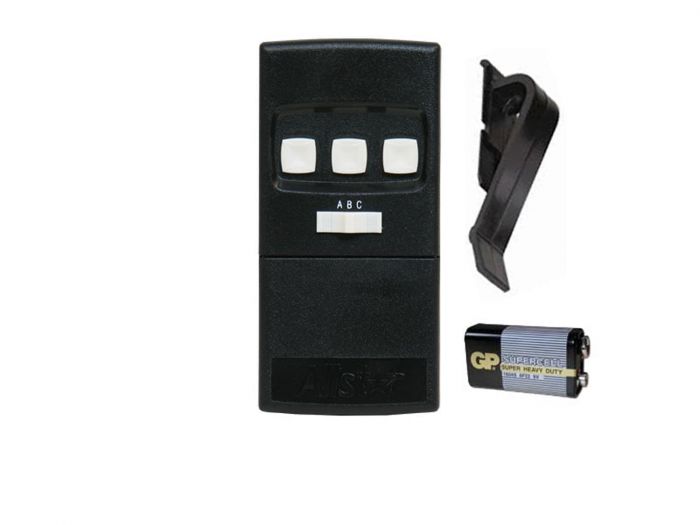
The design of the 110995 is typically compact and utilitarian, often featuring one or two buttons for operation. Its simplicity is one of its strengths, making it straightforward to use for most homeowners. The durable casing is designed to withstand the rigors of being kept in a car or pocket. Unlike modern rolling code technology, the 110995 uses a fixed code system. This means the code it transmits remains the same every time, which is a critical distinction for security and compatibility considerations. Understanding this fixed code mechanism is fundamental to troubleshooting and programming issues.
How The 318mhz Frequency Works
The 318MHz frequency is a radio wave band allocated for various purposes, including garage door openers. When you press a button on the Allstar/Allister 110995 remote, it emits a radio signal at this specific frequency. This signal carries the unique code dictated by the DIP switch settings. The receiver unit, usually mounted on the garage door opener motor in the garage, is designed to listen for signals on the 318MHz frequency. When it detects a signal, it compares the received code with its programmed codes. If there’s a match, it activates the corresponding action, such as opening or closing the garage door.
The effective range of a 318MHz remote can vary depending on factors like battery strength, potential signal interference from other devices (like cordless phones or certain lighting systems operating on similar frequencies), and physical obstructions. Typically, these remotes offer a range of 50 to 100 feet, but this can be significantly reduced under adverse conditions.
It’s important to note that while 318MHz was a popular frequency, newer systems often use different frequencies or more advanced security protocols like rolling codes to enhance security.
The Role Of Dip Switches In Coding
DIP switches are the heart of the coding mechanism for the Allstar/Allister 110995. These are small, often black, slide switches that can be set to either an “on” or “off” position (sometimes represented as 1 or 0). A typical remote might have 8, 9, 10, or even more DIP switches. The specific combination of “on” and “off” settings creates a unique 256, 512, or even 1024-bit code, depending on the number of switches. For example, with 9 DIP switches, there are 2^9 = 512 possible combinations.
To program the remote to a garage door opener, these DIP switches on the remote must be set to match the DIP switches on the receiver board of the garage door opener itself. This is often referred to as “setting the code.
” If even one switch is in a different position on the remote compared to the receiver, the opener will not recognize the signal, and the door will not operate. This physical, manual coding is a hallmark of older garage door opener systems and, while simple, requires careful attention to detail.
Fixed Code Vs. Rolling Code Technology
It’s crucial to understand the difference between the fixed code system used by the Allstar/Allister 110995 and the rolling code technology found in many modern garage door openers. In a fixed code system, the remote transmits the same code every time it’s pressed. This makes it simpler to program, as the code is static. However, it also presents a potential security vulnerability. If someone were to intercept the signal, they could theoretically record it and use it to open your garage door later.
Rolling code technology, on the other hand, uses a sophisticated algorithm. Each time the remote is used, it transmits a new, unique code from a vast, pre-defined sequence. The opener’s receiver is synchronized with the remote and can predict the next code in the sequence. This significantly enhances security, as a recorded signal from a previous use would be invalid for subsequent attempts. The Allstar/Allister 110995, being a classic model, operates on the simpler, fixed code principle.
Credit: www.movingupgaragedoors.com
Compatibility And System Requirements
Before purchasing or attempting to program an Allstar/Allister 110995 remote, verifying compatibility with your existing garage door opener system is paramount. The remote is designed to work with specific brands and models that operate on the 318MHz frequency and utilize the DIP switch coding method. Mismatched frequency or coding technology will render the remote useless.
Compatible Brands And Models
The Allstar/Allister 110995 remote is primarily designed for garage door opener systems manufactured by:
- Allstar
- Allister
- Pulsar
It’s important to note that these brands often shared technology and manufacturing lines, especially during the era when this type of remote was prevalent. Therefore, a remote intended for an Allstar opener might work with an Allister or Pulsar opener, provided the frequency and coding method align. However, it is not compatible with garage door openers that use different frequencies (e.g., 390MHz, 433MHz) or employ rolling code technology. Brands like LiftMaster, Chamberlain, Craftsman, Genie, and Overhead Door, especially their newer models, typically use different frequencies and/or rolling codes, making the 110995 incompatible with them unless they have a legacy receiver board specifically designed for 318MHz fixed code.
Identifying Your Garage Door Opener’s Frequency And Code Type
Determining if your current garage door opener is compatible with the Allstar/Allister 110995 remote requires a bit of investigation. The most reliable method is to consult your garage door opener’s manual. If you don’t have the manual, you can often find information by:
- Locating the Receiver Board: Open the motor unit housing of your garage door opener. The receiver board is a circuit board, often with antenna wires.
- Checking for Frequency Information: Look for labels or markings on the receiver board that indicate the operating frequency, which should be 318MHz.
- Examining DIP Switches: Observe the receiver board for a set of DIP switches. If there are physical DIP switches present, it indicates a fixed code system, which is compatible with the 110995. If you find a “Learn” or “Program” button instead of DIP switches on the receiver, your opener likely uses rolling code technology and is not compatible.
- Checking the Old Remote: If you still have an old remote that works with your opener, you can often find the frequency printed on it. You can also open the old remote to see if it has DIP switches that match the number and configuration you expect for the 110995.
Example: If your garage door opener has a circuit board with 9 DIP switches and a label indicating 318MHz, it is highly likely to be compatible with the Allstar/Allister 110995 remote.
Limitations And Incompatibilities
The primary limitation of the Allstar/Allister 110995 is its reliance on fixed code technology and its specific 318MHz frequency. This means it will not work with:
- Garage door openers using rolling code technology.
- Garage door openers operating on different frequencies, such as 390MHz, 433MHz, or others.
- Many modern openers from brands like LiftMaster, Chamberlain, Craftsman, Genie, etc., as they have largely transitioned to rolling codes and often different frequencies.
- Systems that use keypads for entry, as the remote and keypad systems are often distinct unless specifically designed for universal compatibility.
A common scenario is trying to replace a lost remote for a much older system. If your system predates rolling codes and operates at 318MHz, the 110995 is a strong candidate. However, if your opener was manufactured in the late 1990s or later, the probability of it using rolling codes increases significantly.
Programming The Allstar/allister 110995 Remote
Programming the Allstar/Allister 110995 remote involves synchronizing the code it transmits with the code recognized by your garage door opener’s receiver. This is primarily achieved by setting the DIP switches on both the remote and the receiver unit to match a specific pattern.
Step-by-step Programming Guide
- Locate DIP Switches:
- On the Remote: Carefully open the Allstar/Allister 110995 remote. This usually involves removing a small screw or gently prying apart the casing. You will find a series of small switches (typically 8 to 10) labeled 1 through 9 or 1 through 10.
- On the Receiver: Open the motor unit housing of your garage door opener. Locate the receiver board. You will find a similar set of DIP switches on this board.
- Determine the Desired Code: Decide on the code you want to use. You can either:
- Match Existing Settings: If you have another working remote for the same system, set the DIP switches on the new remote to exactly match the settings on the old one.
- Set a New Code: If you are programming for the first time or replacing all remotes, choose a pattern for the DIP switches. For example, you might set switches 1, 3, and 5 to “on” and the rest to “off.” Ensure this code is not too simple (like all “off”) to avoid accidental activation or security issues.
- Set the DIP Switches:
- Using a small, non-metallic tool (like a ballpoint pen tip or a small screwdriver), carefully move the DIP switches on the new remote to match your chosen code (e.g., “on” for up, “off” for down).
- Now, move the DIP switches on the garage door opener’s receiver board to match the exact same pattern.
- Test the Remote:
- Close the garage door opener motor unit housing.
- Step away from the opener and press the button on your newly programmed Allstar/Allister 110995 remote.
- If the code is set correctly, the garage door should operate.
- Troubleshooting: If the remote doesn’t work, double-check that:
- The DIP switch settings are identical on both the remote and the receiver.
- The battery in the remote is new and correctly inserted.
- The receiver is powered on and functioning.
- There are no obstructions or interference issues.
Pro Tip: It’s often easier to set the new remote’s DIP switches to match an existing, working remote. If you only have one working remote, program the new one to match it exactly. If you’re setting a completely new code, ensure you record the pattern you choose, in case you need to reprogram it later.
Replacing Batteries
The Allstar/Allister 110995 remote typically uses a common coin-cell battery, such as a CR2032 or similar. Over time, batteries deplete, leading to a weaker signal or complete failure of the remote.
- Open the Remote: Carefully open the remote casing as described in the programming steps.
- Identify and Remove Old Battery: Note the type of battery installed and its orientation (+ and – sides). Gently remove the old battery.
- Insert New Battery: Insert a new battery of the same type, ensuring the positive (+) and negative (-) terminals are correctly aligned according to the markings inside the remote.
- Reassemble and Test: Snap the casing back together and test the remote to see if it operates the garage door.
Regular battery replacement, perhaps once a year or when you notice reduced range, can prevent unexpected failures. For guidance on battery replacement for other brands, see resources on resetting garage door remotes.
Resetting The Garage Door Opener Receiver
In some cases, you might need to clear all existing codes from the garage door opener’s receiver and reprogram all your remotes, including the Allstar/Allister 110995. This is often done if you suspect a security issue or if the opener is malfunctioning with multiple remotes.
- Locate the “Learn” or “Program” Button: On the garage door opener’s receiver board, there is usually a button labeled “Learn,” “Program,” or similar. Sometimes, this button is accompanied by an LED indicator light.
- Press and Hold the Button: Press and hold this button for approximately 10-30 seconds. The specific duration can vary by manufacturer. The LED indicator light will typically turn off or change color, indicating that all codes have been erased.
- Reprogram Remotes: Immediately after erasing the codes, you will need to reprogram each remote, including the Allstar/Allister 110995, by following the DIP switch setting procedure outlined above. You typically have a short window (often 30 seconds) to reprogram before the receiver reverts to its non-programmable state.
This process is similar to how you might reset a garage door opener. Always refer to your opener’s manual for precise instructions on clearing codes, as the procedure can differ slightly between models.
Troubleshooting Common Issues
Despite their robust design, Allstar/Allister 110995 remotes can encounter problems. Most issues are related to power, programming, or signal interference.
Remote Not Working At All
If pressing the remote button does nothing:
- Check the Battery: This is the most common culprit. Replace the battery with a new one, ensuring correct polarity.
- Verify DIP Switch Settings: Double-check that the DIP switches on the remote precisely match the DIP switches on the receiver unit. Even a single misplaced switch will prevent operation.
- Inspect for Damage: Look for any physical damage to the remote casing, buttons, or internal components.
- Check Receiver Power: Ensure the garage door opener unit itself is receiving power. Check your circuit breaker.
Remote Works Intermittently Or With Reduced Range
If the remote works sometimes or only when you are very close to the opener:
- Weak Battery: A battery that is low on power can cause intermittent operation and reduced range. Replace the battery.
- Signal Interference: Other electronic devices operating on or near the 318MHz frequency can interfere with the signal. This includes certain types of LED lighting, wireless doorbells, baby monitors, or even neighboring garage door openers. Try turning off potential sources of interference to see if the remote’s performance improves.
- Antenna Issues: Check the antenna wire on the garage door opener’s receiver. Ensure it is intact, not damaged, and hanging freely, not coiled or touching metal.
- Obstructions: Metal objects, large structures, or even dense foliage between the remote and the opener can weaken the signal.
Garage Door Opener Responds To Other Remotes But Not This One
If other remotes work fine, but the Allstar/Allister 110995 does not:
- Programming Error: The most likely cause is an incorrect DIP switch setting. Re-verify the settings on both the remote and the receiver.
- Faulty Remote: The remote itself may be defective. If you have tried programming it multiple times with correct settings and a fresh battery, and it still doesn’t work, the remote may need replacement.
- Receiver Compatibility: While less common if other remotes work, ensure the receiver is indeed designed for 318MHz fixed code operation.
Example Scenario: A homeowner found their Allstar remote only worked when they were practically inside the garage. After replacing the battery with a fresh one, the range improved significantly, indicating the battery was the primary issue.
Maintenance And Longevity
Proper maintenance ensures the Allstar/Allister 110995 remote continues to function reliably for years. While it’s a relatively simple device, a few practices can extend its lifespan and prevent common failures.
Regular Battery Replacement
As mentioned, batteries are the most frequent cause of remote failure. Make it a habit to replace the battery annually, or at the first sign of reduced performance. This proactive approach prevents the inconvenience of a non-functional remote when you need it most.
Keeping a spare battery on hand is also advisable.
Keeping The Remote Clean
The casing of the remote can accumulate dirt and grime, especially if kept in a car. Periodically wipe down the remote with a dry or slightly damp cloth. Avoid using harsh chemicals or solvents, which could damage the plastic or internal electronics.
Ensure the button contacts remain clean for optimal performance.
Protecting From Environmental Factors
Avoid exposing the remote to extreme temperatures, moisture, or direct sunlight for prolonged periods. While designed for typical automotive environments, excessive heat or cold can degrade the battery and internal components. Water damage can permanently destroy the electronics. If the remote gets wet, remove the battery immediately and allow it to dry thoroughly before reinserting it.
Securing The Remote
The Allstar/Allister 110995, like any garage door remote, is a potential security risk if lost or stolen. If you misplace your remote, it’s crucial to erase its code from the garage door opener’s receiver immediately. This prevents unauthorized access to your garage. You can then reprogram your remaining remotes and the new one once found or replaced. This aligns with best practices for resetting garage door remotes from various brands.
Periodic System Checks
Beyond the remote itself, ensure the garage door opener system is in good working order. This includes:
- Lubricating moving parts: Regularly lubricating the garage door tracks, rollers, and springs helps the entire system operate smoothly, reducing strain on the opener motor and potentially the remote’s signal. Refer to guides on how to lubricate garage door rollers for detailed steps.
- Checking the chain/belt: Ensure the chain or belt drive on the opener is properly tensioned. An improperly adjusted chain can lead to operational issues. For guidance, see how to adjust the chain on a garage door opener.
- Ensuring smooth door operation: The garage door should move freely without excessive force. If the door is binding or difficult to move manually, address mechanical issues before relying on the remote.
A well-maintained garage door system ensures the remote operates efficiently and reliably.