
Measuring a garage door might seem easy at first, but getting the right numbers is more than just using a tape measure. One small mistake can mean a door that doesn’t fit, extra costs, or even safety problems. Whether you want to replace an old garage door, buy a new one, or just check your home’s details, knowing how to measure a garage door properly is important.
Many people, even experienced DIYers, miss a few key details that can cause trouble later.
This guide gives you everything you need to measure any garage door space like a pro. You’ll learn what tools to use, what parts of the opening to focus on, and what numbers you need to write down. You’ll also see why getting these details right matters for installation, safety, and the look of your home.
Even if you’ve never done this before, you’ll finish reading with the confidence to measure any garage door without worry.
Why Accurate Measurement Matters
Before you start, it’s good to know why accurate measurement is so important. A garage door is usually the biggest moving part of any house. Even a small mistake in measurement can lead to several problems:
- The door may not fit the opening, so it won’t close or seal correctly.
- Gaps around the door can let in wind, rain, or pests.
- The garage door opener might not work if the door is the wrong size.
- You might have to pay for returns, custom changes, or even a new door.
Most garage door companies require exact measurements to order the right door. If you guess, you risk wasting time and money. That’s why it’s always best to measure carefully and double-check your numbers.
Tools You Need To Measure A Garage Door
You don’t need fancy equipment, but having the right tools helps you get accurate results. Here’s what you should have ready:
- Tape measure (preferably 25 feet or longer)
- Step ladder (for reaching the top of the opening)
- Level (to check if the floor and header are straight)
- Notepad and pencil (or a phone/tablet for notes)
- Flashlight (if the garage is dark)
- Helper (optional, but useful for holding the tape measure)
Having these tools on hand makes the job easier, especially if your garage is large or cluttered.
Key Parts Of A Garage Door Opening
It’s important to understand the basic terms for parts of the garage door area before you start measuring:
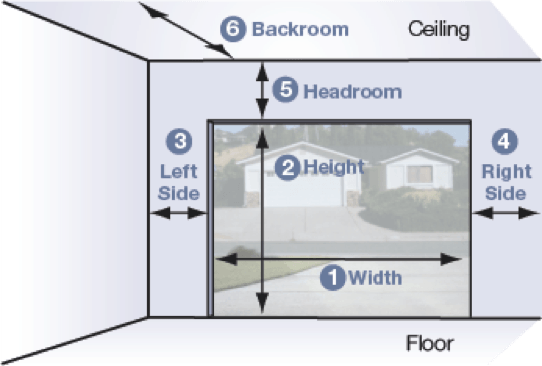
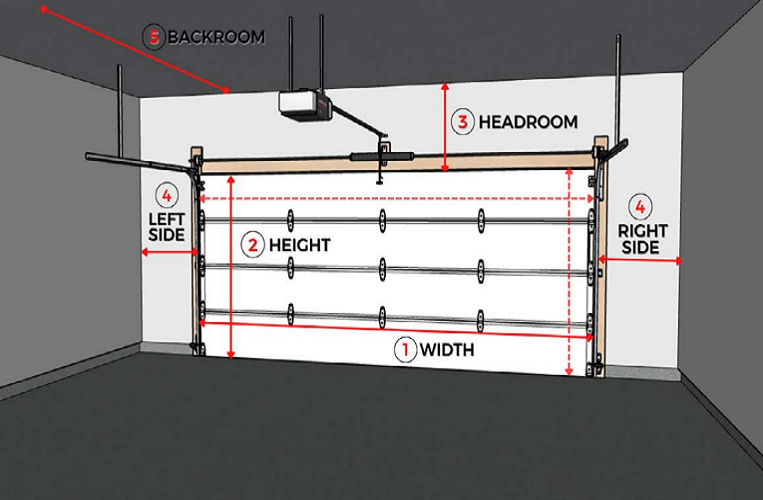
- Width: The distance from the left side to the right side of the door opening.
- Height: The distance from the floor to the top of the door opening.
- Sideroom: The wall space on each side of the opening, inside the garage.
- Headroom: The space between the top of the opening and the ceiling.
- Backroom: The space from the opening back to the rear wall of the garage.
You’ll need to measure all these parts to make sure your new door fits and works correctly.
Step-by-step Guide: How To Measure A Garage Door
Let’s go through each step in detail. Don’t rush—accuracy matters more than speed.
1. Measure The Width Of The Opening
Start by measuring the width of the finished door opening. This is the clear space between the left and right sides, not including any trim or frame.
- Place the tape measure at the widest part, from one side to the other.
- Write down the number in inches and feet (for example, 96 inches or 8 feet).
- Check the top, middle, and bottom to see if the sides are straight. If they’re not, use the smallest number.
Pro tip: Most residential garage doors are between 8 and 18 feet wide. Double garage doors are usually 16 feet wide.
2. Measure The Height Of The Opening
Next, measure the height from the floor to the top of the opening.
- Start at the finished floor (not the concrete foundation if it’s higher or lower).
- Extend the tape to the highest point of the opening.
- Write down the number. Again, check both sides and the middle.
Common mistake: Measuring only to the bottom of the header or trim. Always measure the full clear opening.
3. Measure The Sideroom
The sideroom is the wall space on each side of the opening, inside the garage. This is important because the door tracks and hardware need room to fit.
- Measure from the edge of the opening to the nearest wall, pipe, or obstacle on both the left and right sides.
- For most standard garage doors, you need at least 3.5 inches of sideroom on each side (sometimes more for special doors or openers).
Non-obvious insight: If you want an automatic opener, you may need more sideroom for the motor or brackets. Always check the opener’s requirements.
4. Measure The Headroom
Headroom is the space above the top of the opening up to the ceiling or lowest beam.
- Start at the top of the finished opening and measure straight up to the ceiling or first obstruction.
- Standard doors need at least 10–12 inches of headroom. Some openers and specialty doors need more.
Example: If you want a roll-up or high-lift garage door, the headroom requirements can double. Always check before buying.
5. Measure The Backroom
Backroom is the space inside the garage, from the opening back to the nearest wall or obstacle.
- Place the tape at the opening and measure straight back along the ceiling or floor.
- You need the height of the door plus at least 18 inches (for the opener and track). For example, if your door is 7 feet (84 inches) tall, you’ll need at least 8.5 feet (102 inches) of backroom.
Practical tip: Watch for lights, pipes, or storage that might block the path of the garage door as it opens.
6. Measure Obstructions And Notes
Many people forget to note obstructions like pipes, ductwork, or shelves. These can block the tracks or the opener.
- Walk around and look for anything above, beside, or behind the opening.
- Write down the distance from the opening to each obstacle.
- Take photos if you’re sending information to a garage door company.
Non-obvious insight: Even a small pipe near the ceiling can block the opener track. It’s better to find this now than after buying a door.
Example: Measuring A Typical One-car Garage Door
Let’s look at a real example. Imagine you have a standard single-car garage.
- Width: 8 feet 2 inches (98 inches)
- Height: 7 feet (84 inches)
- Sideroom (left): 5 inches
- Sideroom (right): 5 inches
- Headroom: 14 inches
- Backroom: 9 feet (108 inches)
- Obstructions: None
These measurements would work for most standard garage doors and openers. If you have less headroom, you might need a special low-headroom track or a different type of opener.
Measuring For Special Garage Doors
Not all garage doors are the same. Some homes have custom sizes, oversized doors, or special designs. Here’s what to watch for:
Oversized Or Rv Garage Doors
These are usually 10–14 feet wide and 8–12 feet tall. Always measure carefully, as small errors can cost a lot with custom doors.
- Check headroom and backroom. Big doors need more space for tracks and springs.
- Some RV doors need up to 16–18 inches of headroom.
Carriage House Or Swing-out Doors
These open outward, not up and over. You need more sideroom outside, and space inside for the doors to swing.
- Measure the area in front of the garage for clearance.
- Measure the door opening and the frame just as you would for a standard door.
Roll-up And High-lift Doors
These doors coil up or run along the ceiling. They need more headroom than standard overhead doors.
- Measure the headroom very carefully.
- Note any pipes, beams, or storage racks in the way.
Pro tip: Always tell the garage door company if you want a special door. They might send a professional to check your measurements.
Measuring For A Replacement Garage Door
If you’re replacing an old garage door, you still need to measure the opening—not just the old door. Doors can shift, and openings can change over time.
- Remove any trim or weatherstripping to get the true opening size.
- Measure the frame, not the door panels.
- Check for uneven floors or headers, especially in older homes.
Example: If your old door is warped or doesn’t seal, measuring the opening can show you if you need to fix the frame before installing a new door.
Understanding Standard Garage Door Sizes
Most homes use standard garage door sizes. Knowing these can help you compare your measurements and spot any problems.
Here’s a quick comparison of common sizes:
| Type | Width (feet) | Height (feet) | Common Use |
|---|---|---|---|
| Single Car | 8, 9, 10 | 7, 8 | Standard homes, small garages |
| Double Car | 12, 14, 16, 18 | 7, 8 | Two cars, large garages |
| RV/Oversized | 10, 12, 14 | 8, 10, 12 | RVs, trucks, special use |
If your opening size is different, don’t worry. Custom doors are available, but they usually cost more and take longer to deliver.
Common Mistakes When Measuring A Garage Door
Avoid these errors to save time and money:
- Measuring only the old door, not the opening. The opening is what matters for a good fit.
- Ignoring trim or weatherstripping. Remove these before measuring for a clear view.
- Forgetting to check all measurements at multiple spots. Walls and floors can be uneven.
- Not writing down measurements in both inches and feet. This avoids confusion.
- Missing obstructions. Pipes, wires, or shelves can block tracks or openers.
Non-obvious insight: If you’re unsure, take photos and send your measurements to a garage door installer. They can double-check before you order.
Tips For Accurate Measuring
- Always measure twice. Write down the numbers and check again.
- Use a helper for large doors. One person holds the tape, the other reads.
- Use a level to check if the floor or header is slanted.
- If you find any unevenness, use the smallest measurement for width and height.
- Record everything, even if you think it’s not important. Better too much info than too little.
When To Call A Professional
If your garage has special conditions—such as very low headroom, sloped floors, or custom framing—it’s smart to call a garage door professional. They have experience with tricky spaces and can guarantee a perfect fit.
Some companies offer free measuring and quotes. This can save you time and avoid costly mistakes.
Comparing Garage Door Types And Their Measurement Needs
Different garage door types have their own measurement needs. Here’s a quick look at how they compare:
| Door Type | Headroom Needed | Sideroom Needed | Backroom Needed |
|---|---|---|---|
| Sectional (Standard) | 10–12 inches | 3.5 inches | Door height + 18 inches |
| Roll-Up | 16–24 inches | 4–6 inches | Door height + 24 inches |
| Carriage/Swing-Out | 6–8 inches | More outside clearance | Door swing distance |
| High-Lift | 12–36 inches | 4–6 inches | Door height + 24 inches |
This helps you see at a glance what’s needed for each type. Always check the manufacturer’s requirements for your chosen style.

How Measurements Affect Garage Door Openers
Your garage door opener also needs space to work. If you plan to add or replace an opener, check these points:
- Headroom: Some openers need more space above the door.
- Backroom: The opener rail must fit along the ceiling.
- Sideroom: Wall-mounted openers need more space on the side.
Example: If your garage ceiling is low, you might need a jackshaft opener, which mounts on the wall instead of the ceiling.
Pro tip: Always check the opener’s manual for exact space needs before buying.
Dealing With Odd-shaped Or Non-standard Openings
Some garages have arched, angled, or extra-wide openings. Here’s how to handle these cases:
Arched Openings
- Measure the width and height as if the opening was square (ignore the arch at first).
- Measure the height to the lowest part of the arch.
- Note the highest and lowest points for custom-fit doors.
Angled Or Irregular Openings
- Measure at several points across the opening.
- Use the narrowest width and shortest height for your main measurements.
- Take photos to show the installer.
Extra-wide Or Tall Openings
- Measure carefully, as small errors can have big effects.
- Confirm with the door company about custom sizing and support needs.
Non-obvious insight: For arched openings, you can often install a square door and fill the arch with trim for a clean look.
Preparing Your Garage Before Measuring
A little preparation makes measuring easier and more accurate:
- Clean the area around the opening. Move cars, bikes, or boxes out of the way.
- Remove old weatherstripping or trim if possible.
- Clear away cobwebs or dust so you can see the edges clearly.
- Make sure the floor is dry and safe to stand on.
These simple steps help you get the best measurements and avoid mistakes.
What To Do With Your Measurements
Once you have all your numbers, here’s what to do next:
- Write them down clearly, labeling each measurement (width, height, sideroom, headroom, backroom).
- Take photos of the opening and any unusual features.
- Contact garage door companies with your measurements for quotes.
- Double-check requirements for the door type and opener you want.
- Ask questions if you’re not sure—better to ask now than order the wrong door.
Sending Your Measurements To Installers Or Suppliers
Most garage door companies will want:
- The width and height of the opening (in inches and feet)
- Sideroom, headroom, and backroom
- Details about obstructions or unusual shapes
- Photos of the opening and inside the garage
Sending complete and clear information helps you get accurate quotes and the right product the first time.
Cost Impact Of Incorrect Measurements
Measuring incorrectly can be expensive. Here’s why:
- Custom doors based on wrong measurements cannot be returned.
- Extra installation costs if the opening needs to be changed.
- Delays while waiting for the correct door to arrive.
- Paying for both a door and frame repair if the fit is wrong.
Example: Ordering a door that’s 2 inches too wide means you might need to rebuild part of your garage wall, which can cost hundreds or thousands of dollars.
Professional Measuring Services
Many garage door companies offer measuring services as part of their package. This can save you time and remove the risk of mistakes.
- Some companies include this for free with installation.
- Others charge a small fee, which is often credited toward your purchase.
You can find more details about measuring services on the Home Depot website.
Garage Door Measurement Checklist
Here’s a quick checklist to make sure you don’t miss anything:
- [ ] Measure width of the opening (top, middle, bottom)
- [ ] Measure height of the opening (both sides, middle)
- [ ] Measure sideroom (left and right)
- [ ] Measure headroom (top of opening to ceiling)
- [ ] Measure backroom (opening to rear wall)
- [ ] Note any pipes, beams, shelves, or wires
- [ ] Take clear photos of the area
- [ ] Write down all numbers in inches and feet
Real-world Examples And Troubleshooting
Example 1: Uneven Floor
John measured his garage door and found the right side was half an inch higher than the left. He used the lower height for ordering and added a threshold seal to fill the gap. The door fit perfectly, and no water leaked in.
Example 2: Pipe Blocking Headroom
Maria didn’t check for pipes. After her new door arrived, the opener rail hit a water pipe. She had to pay for a plumber to move the pipe, costing extra money. If she had measured headroom including the pipe, this could have been avoided.
Example 3: Narrow Sideroom
Alex’s old garage had only 2. 5 inches of sideroom. Standard tracks wouldn’t fit, but he found a slim-line track system that worked. Always check for special hardware if your space is tight.
Frequently Asked Questions
What Is The Standard Size For A Garage Door?
Standard single garage doors are usually 8 or 9 feet wide and 7 or 8 feet high. Double garage doors are often 16 feet wide. However, you should always measure your opening, as some homes have custom sizes.
How Much Headroom Do I Need For A Garage Door?
Most garage doors need 10–12 inches of headroom above the opening for the tracks and springs. Some special doors or openers need more. Always measure from the top of the opening to the ceiling or the lowest obstruction.
Can I Measure My Garage Door Myself, Or Do I Need A Professional?
You can measure your garage door yourself with a tape measure and some basic tools. However, if your garage has unusual shapes, tight spaces, or many obstructions, it’s smart to call a professional to avoid mistakes.
Why Do I Need To Measure The Sideroom And Backroom?
Sideroom is needed for the tracks and hardware to fit beside the door. Backroom is needed for the door panels to move along the ceiling and for the opener rail. Not enough space means the door or opener might not work.
What Should I Do If My Garage Opening Is Not A Standard Size?
If your opening is not standard, you can order a custom-sized garage door. Measure carefully, write down all dimensions, and talk to a garage door company for advice. Custom doors cost more, but they will fit your space exactly.
Measuring a garage door is more than a simple tape measure job—it’s about making sure your new door fits, works, and lasts for years. By following the steps above, watching for common mistakes, and double-checking your measurements, you’ll save money and avoid headaches.
If you’re unsure or your garage is unusual, don’t hesitate to get professional help. With the right measurements, you’ll enjoy a garage door that looks good, works smoothly, and protects your home for a long time.