
Now Reading: How Far Away Can A Garage Door Opener Work: Range Guide
- 01
How Far Away Can A Garage Door Opener Work: Range Guide

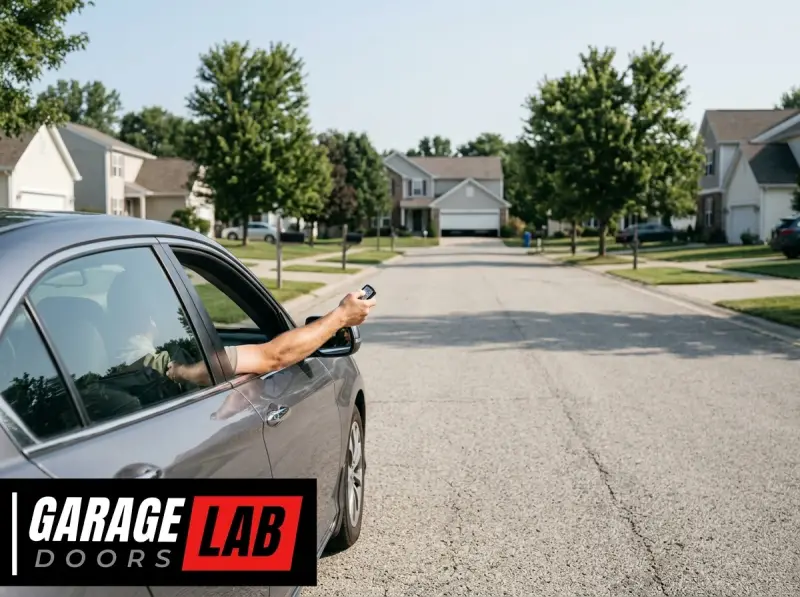
The convenience of a garage door opener is undeniable. With the simple press of a button, your garage door glides open, welcoming you home or securing your property as you depart. But have you ever wondered about the limits of this technology?
How far away can a garage door opener actually work? This question often arises when you’re pulling into your driveway from a distance, or perhaps when you’re trying to operate the door from a more remote location. Understanding the effective range of your garage door opener is crucial for maximizing its utility and ensuring reliable operation.
The effective range of a garage door opener is influenced by a confluence of factors, primarily revolving around radio frequency (RF) technology, environmental conditions, and the specific components of your system. While manufacturers often cite a general range, real-world performance can vary significantly.
This article will explore the typical distances you can expect, the underlying technological principles, and the various elements that can either extend or diminish your opener’s reach, ensuring you get the most out of this essential home automation feature.
Key Takeaways
- Standard Range: Most modern garage door openers operate effectively within a 200-500 foot range under ideal conditions.
- Radio Frequency (RF): Garage door openers use RF signals, typically in the 310-315 MHz band, to communicate with the opener motor.
- Obstructions are Key: Physical barriers like walls, metal structures, and even dense foliage can significantly reduce the signal range.
- Interference Matters: Other electronic devices emitting RF signals (e.g., cordless phones, Wi-Fi routers, baby monitors) can interfere with the opener’s signal.
- Antenna Quality: The design and condition of the antenna on both the remote and the opener unit play a vital role in signal strength and range.
- Power Output: The transmitter’s power output is a regulated factor, but even slight variations can impact range.
- Environmental Factors: Weather conditions, such as heavy rain or snow, can sometimes attenuate RF signals.
- Extending Range: Solutions like external antennas or signal boosters can potentially extend the opener’s working distance.
Understanding Garage Door Opener Technology
At its core, a garage door opener system relies on radio frequency (RF) communication. When you press a button on your remote, it transmits a specific radio signal. This signal travels through the air to a receiver unit, typically mounted on the garage door opener motor assembly in your garage. Upon receiving the correct signal, the receiver instructs the motor to open or close the garage door.
Radio Frequency Basics
The most common frequency bands used by residential garage door openers in North America are around 310-315 MHz. This frequency range is chosen because it offers a good balance between signal penetration and antenna size. Lower frequencies generally travel farther and penetrate solid objects better, but require larger antennas. Higher frequencies offer more bandwidth and smaller antennas but have shorter ranges and are more easily blocked. The specific frequency is regulated by the Federal Communications Commission (FCC) to minimize interference between different devices.
Signal Transmission And Reception
The process is straightforward:
- Remote Transmitter: Your garage door remote contains a small transmitter circuit and an antenna. When you press a button, it generates a specific digital code and broadcasts it as an RF signal.
- Signal Propagation: The RF signal travels outwards from the remote. Its strength diminishes with distance, a phenomenon known as path loss.
- Receiver Unit: The receiver in the garage door opener unit also has an antenna. It’s designed to “listen” for signals on the specific frequency used by the opener.
- Decoding and Action: If the receiver detects a signal that matches its pre-programmed code, it decodes it and sends the appropriate command to the opener motor.
The quality of the antenna on both the remote and the receiver is paramount. A well-designed and properly positioned antenna can capture and transmit signals more effectively, leading to a longer working range. Similarly, the power output of the transmitter in the remote is a critical factor, though this is regulated to prevent excessive power consumption and interference.
Factors Affecting Garage Door Opener Range
While the theoretical capability of the technology sets a baseline, numerous real-world factors can significantly impact how far away your garage door opener will reliably work. Understanding these influences is key to troubleshooting range issues and optimizing performance.
Distance From The Garage
The most obvious factor is simply distance. As you move further away from the garage, the RF signal from your remote weakens. This weakening is not linear; it follows an inverse square law, meaning the signal strength decreases rapidly as distance increases. For example, doubling the distance reduces the signal strength to one-quarter of its original power. This is why a remote that works perfectly when you’re 50 feet away might struggle at 200 feet.
Obstructions: The Silent Killers Of Range
Physical obstructions are arguably the biggest culprits in reducing garage door opener range. RF signals, especially at the frequencies used by these devices, are susceptible to being absorbed, reflected, or scattered by solid objects.
- Walls and Doors: Each wall between your remote and the garage receiver weakens the signal. A single exterior wall might have a minor impact, but multiple walls, especially those containing metal studs or insulation with metallic backing, can significantly degrade the signal. The garage door itself, particularly if it’s a solid metal or heavily insulated door, can also act as a barrier when closed.
- Metal Structures: Metal is a particularly effective signal blocker. Cars, metal fences, sheds, and even metal furniture inside or near the garage can create dead zones or significantly reduce the effective range. The metal chassis of your car, for instance, can act as a Faraday cage, attenuating the signal from your remote.
- Trees and Foliage: While less of a barrier than solid structures, dense trees and thick foliage, especially when wet from rain or dew, can absorb and scatter RF signals, reducing range.
- Other Buildings: If your garage is not directly visible from your typical operating location, other buildings can obstruct the signal path.
Radio Frequency Interference
The airwaves are a crowded place, and your garage door opener’s RF signal can be drowned out or confused by signals from other electronic devices. This electromagnetic interference (EMI) is a common cause of reduced range.
- Household Electronics: Devices operating on similar frequencies or emitting strong RF signals can interfere. This includes:
- Cordless phones
- Wi-Fi routers and other wireless networking equipment
- Baby monitors
- Microwave ovens (though typically only when actively in use and very close)
- Certain types of LED lighting
- Security systems
- Neighboring Openers: In densely populated areas, signals from your neighbors’ garage door openers can sometimes interfere, especially if they use older, non-rolling code technology. Modern systems use rolling codes to mitigate this, but interference can still occur.
- Power Lines: High-voltage power lines can sometimes emit electromagnetic fields that interfere with RF signals.
Antenna Issues And System Health
The performance of your garage door opener’s RF system is heavily dependent on the condition and design of its antennas.
- Remote Antenna: The antenna in your remote is usually a small piece of wire or circuitry. If it becomes damaged, corroded, or is improperly positioned (e.g., buried deep within a bag or pocket), its ability to transmit effectively will be compromised.
- Opener Receiver Antenna: The receiver unit in your garage has its own antenna, often a thin wire hanging down from the motor unit. This antenna should ideally hang vertically and be unobstructed. If it’s been cut, damaged, coiled up, or is too close to metal components of the opener or garage structure, its reception capabilities will be severely diminished.
- Age and Wear: Over time, electronic components can degrade. The transmitter in an older remote might weaken, or the receiver in the opener unit might become less sensitive.
Environmental Conditions
While less impactful than obstructions or interference, certain environmental conditions can subtly affect RF signal strength.
- Temperature Extremes: While garage door openers are designed to withstand typical temperature fluctuations, extreme heat or cold can sometimes affect the performance of electronic components, including transmitters and receivers.
- Humidity and Precipitation: Heavy rain, snow, or high humidity can slightly attenuate RF signals, particularly over longer distances. Water absorbs and reflects radio waves.
Typical And Extended Ranges
Understanding the theoretical and practical ranges of garage door openers provides a benchmark for performance.
Standard Operating Range
Most modern garage door openers are designed to operate reliably within a range of 200 to 500 feet under optimal conditions. This range is sufficient for most users, allowing them to open the garage door as they approach their driveway. Manufacturers often state this range in their product specifications.
Factors contributing to this standard range include:
- FCC Regulations: Power output is limited by the FCC to prevent interference, which inherently caps the maximum effective range.
- Antenna Design: Standard antennas are optimized for a balance of size, cost, and performance within this typical range.
- Signal Strength: The signal strength is designed to be robust enough to overcome minor atmospheric variations and a single layer of standard building materials.
What Is Considered “far Away”?
When people ask “how far away can a garage door opener work? “, they often mean pushing beyond the standard range. Achieving reliable operation beyond 500 feet becomes increasingly challenging and depends heavily on mitigating the factors discussed earlier.
- Ideal Conditions: In a completely open area with no obstructions or interference, some openers might transmit signals effectively for up to 1000 feet or more. However, this scenario is rare in a typical residential setting.
- Challenging Environments: In a suburban environment with multiple houses, vehicles, and potential RF noise, the effective range might be reduced to 100 feet or even less.
Real-world Scenarios And Examples
Let’s consider a couple of scenarios:
Example 1: Suburban Driveway
- Setup: A typical suburban home with a two-car garage. The driveway is about 75 feet long. The house has a metal garage door.
- Expected Performance: The opener should work reliably from the end of the driveway (approx. 75 feet). It might also work from the street, perhaps 100-150 feet away, provided there are no significant obstructions like parked cars or dense hedges. Operating from a block away (300+ feet) is unlikely due to multiple house structures and potential RF interference.
Example 2: Rural Property
- Setup: A home on a larger rural property with a long driveway (300 feet) leading to a detached garage. The path is relatively clear, with some trees but minimal other structures.
- Expected Performance: The opener might work reliably from the end of the driveway (300 feet) and potentially even further down the main road, perhaps 400-600 feet, due to fewer obstructions and less RF interference. However, the garage door itself being closed could still limit range when approaching from the furthest point.

Credit: www.ebay.com
Extending Your Garage Door Opener’s Range
If you find your garage door opener’s range is insufficient for your needs, there are several strategies you can employ to potentially extend its working distance. These solutions range from simple adjustments to installing additional hardware.
Optimizing Existing Components
Before investing in new equipment, ensure your current system is performing at its best.
- Check the Receiver Antenna: This is often the most overlooked component.
- Ensure the antenna wire (usually a thin wire hanging from the motor unit) is hanging vertically and is fully extended.
- Make sure it’s not coiled up, tied in a knot, or touching any metal parts of the opener or garage structure.
- If the wire is damaged, it may need to be replaced.
- Positioning the antenna away from potential sources of interference within the garage can also help.
- Replace Old Batteries: A weak battery in your remote can significantly reduce its transmission power. Replacing the battery with a fresh, high-quality one is a simple and often effective first step.
- Inspect the Remote: Ensure the remote itself isn’t damaged. A cracked casing or corroded battery contacts can affect performance.
Reducing Interference
Minimizing RF interference can effectively increase your opener’s usable range.
- Identify Sources: Try to identify potential sources of interference. This might involve turning off or moving suspect devices (like cordless phone bases or Wi-Fi routers) temporarily to see if the opener’s range improves.
- Shielding: In some cases, if a particular device is causing persistent interference, it might be possible to shield it, although this is often impractical for household items.
- Frequency Considerations: Newer openers use rolling code technology and operate on specific frequencies to minimize interference from neighboring systems. If you have a very old opener, upgrading might be a solution.
Installing An External Antenna Or Signal Booster
For a more significant range extension, consider adding external hardware.
- External Antenna Kit: Several manufacturers offer external antenna kits designed to be installed on the garage door opener motor unit. These kits typically include a more robust antenna and the necessary wiring to connect it to the receiver board.
- Benefit: A larger, more efficient external antenna can significantly improve both transmission and reception.
- Considerations: Installation can be more involved, requiring some basic wiring. Ensure compatibility with your specific opener model. The antenna placement is crucial for optimal performance.
- Range Extender/Signal Booster: These devices are less common for standard garage door openers but exist for some smart home systems. They essentially act as repeaters, picking up the signal from the remote and re-transmitting it with greater strength.
- Benefit: Can potentially offer the most significant range increase.
- Considerations: These are often more expensive and may require professional installation. Compatibility with your specific opener model is essential.
Upgrading Your Opener System
If your current opener is very old or consistently underperforming despite troubleshooting, a complete system upgrade might be the most effective solution.
- Newer Technology: Modern garage door openers often feature improved RF technology, more efficient antennas, and enhanced susceptibility to interference.
- Smart Openers: Many newer openers integrate with smart home systems, offering control via smartphone apps. These systems sometimes use different communication protocols (like Wi-Fi or Bluetooth alongside RF) which might offer different range characteristics or integration possibilities.
- Professional Consultation: A garage door professional can assess your situation and recommend the best opener model or range-extending solution for your specific needs and property layout. You can learn more about the general costs involved in replacing a garage door opener at How Much for a Garage Door: Costs, Factors, and Savings Tips.
Troubleshooting Common Range Issues
Experiencing reduced range with your garage door opener can be frustrating. Here’s a systematic approach to troubleshooting the problem.
Step 1: The Simple Checks
Always start with the easiest and most common solutions.
- Battery: Replace the battery in your remote. Even if it seems to have some life left, a fresh battery provides maximum transmission power.
- Obstructions (Immediate Area): Ensure nothing is blocking the direct line of sight between your remote and the garage door opener unit. This includes the car itself, other objects on your driveway, or items stored near the garage door opening.
- Antenna Position: Check the antenna wire on the opener motor unit. Is it hanging freely? Is it touching metal? Gently adjust it to hang vertically and away from metal components.
Step 2: Environmental Assessment
Consider the conditions under which the range issue occurs.
- Time of Day/Weather: Does the problem occur only during specific weather conditions (e.g., heavy rain)? While less common, it’s worth noting.
- Interference Check: Are there new electronic devices in or near the garage? Try turning off potential sources of interference one by one (e.g., wireless speakers, Wi-Fi extenders, baby monitors) to see if the range improves. Pay attention to devices operating on similar frequencies.
- Neighboring Signals: If you live in a dense area, consider if multiple garage doors opening simultaneously might be causing interference.
Step 3: System-specific Checks
Dive deeper into the components of your opener system.
- Multiple Remotes: If you have multiple remotes, test each one. If only one remote has a reduced range, the issue likely lies with that specific remote (battery, internal antenna, or damage). If all remotes have reduced range, the problem is more likely with the receiver unit or widespread interference.
- Keypad Performance: If you have a wireless keypad, does it also exhibit reduced range? If the keypad works fine from a distance but the remote doesn’t, it points more towards the remote or the receiver’s ability to pick up the remote’s specific signal.
- Opener Model and Age: Newer openers generally have better range and resistance to interference. If your opener is over 10-15 years old, its components might simply be degrading. Consider consulting the manual for your specific model or searching for known issues online. FCC regulations on garage door opener frequencies can also provide context.
Step 4: Advanced Solutions And Professional Help
If the above steps don’t resolve the issue, consider more advanced options.
- Reprogramming: Sometimes, reprogramming the remotes to the opener can resolve communication glitches. Refer to your owner’s manual or search for specific instructions for your model, such as How Do I Reset My Garage Door Opener: Step-by-Step Guide.
- External Antenna Installation: As discussed earlier, installing an external antenna kit can significantly boost range. This may require some technical skill.
- Professional Service: If you’re uncomfortable with advanced troubleshooting or hardware installation, it’s best to call a qualified garage door technician. They have the tools and expertise to diagnose complex issues, test signal strength accurately, and recommend the most effective solutions, whether it’s repairing the existing system or recommending an upgrade.
Garage Door Opener Range Comparison
Different types of garage door openers and related technologies can offer varying ranges. While most standard openers operate on similar RF principles, accessories like keypads or smart home integrations can introduce different communication methods.
Here’s a general comparison of typical ranges:
| Device/Technology | Typical Range (Ideal Conditions) | Primary Factors Affecting Range | Notes |
|---|---|---|---|
| Standard Remote Control (310-315 MHz RF) | 200-500 feet | Obstructions, Interference, Antenna Quality, Battery Power | Most common type. Range is highly variable in real-world conditions. |
| Wireless Keypad (External) | 150-400 feet | Obstructions, Interference, Battery Power, Weather | Often uses similar RF technology to remotes but may have a slightly different antenna design. Range can be affected by mounting location. |
| Smart Garage Door Opener (Wi-Fi/App Control) | Variable (Wi-Fi range dependent) | Home Wi-Fi Signal Strength, Router Placement, Internet Connectivity | The opener communicates with your home Wi-Fi. Range is limited by your Wi-Fi network’s coverage, not direct RF from the phone. Can be controlled from anywhere with internet access. |
| Smart Garage Door Opener (Bluetooth) | 30-100 feet | Bluetooth Signal Strength, Obstructions | Typically used for proximity detection or direct control when close to the garage. Range is significantly shorter than RF or Wi-Fi. |
| Garage Door Opener with External Antenna Kit | 500-1000+ feet | Quality of External Antenna, Installation, Reduced Interference | Requires dedicated hardware installation. Offers significant potential range increase over standard setups. |
Case Study: Enhancing Range For A Large Property
Consider a homeowner with a large rural property. Their garage is situated approximately 600 feet from the main house, down a long, winding driveway with several mature trees. The standard 200-500 foot range of their existing garage door opener remote was insufficient, requiring them to drive almost to the garage before the remote would work.
Solution Implemented:
- Diagnosis: A technician identified that the primary issues were the distance and the foliage acting as obstructions. The existing remote’s antenna was also noted to be slightly corroded.
- Initial Steps: The remote’s battery was replaced, and the opener’s antenna was cleaned and repositioned to hang vertically. This provided a marginal improvement, extending the range to perhaps 550 feet, but still not consistently reliable.
- Hardware Upgrade: The homeowner opted to install an external antenna kit specifically designed for their garage door opener model. This involved mounting a more robust antenna on the exterior of the garage near the opener unit and running